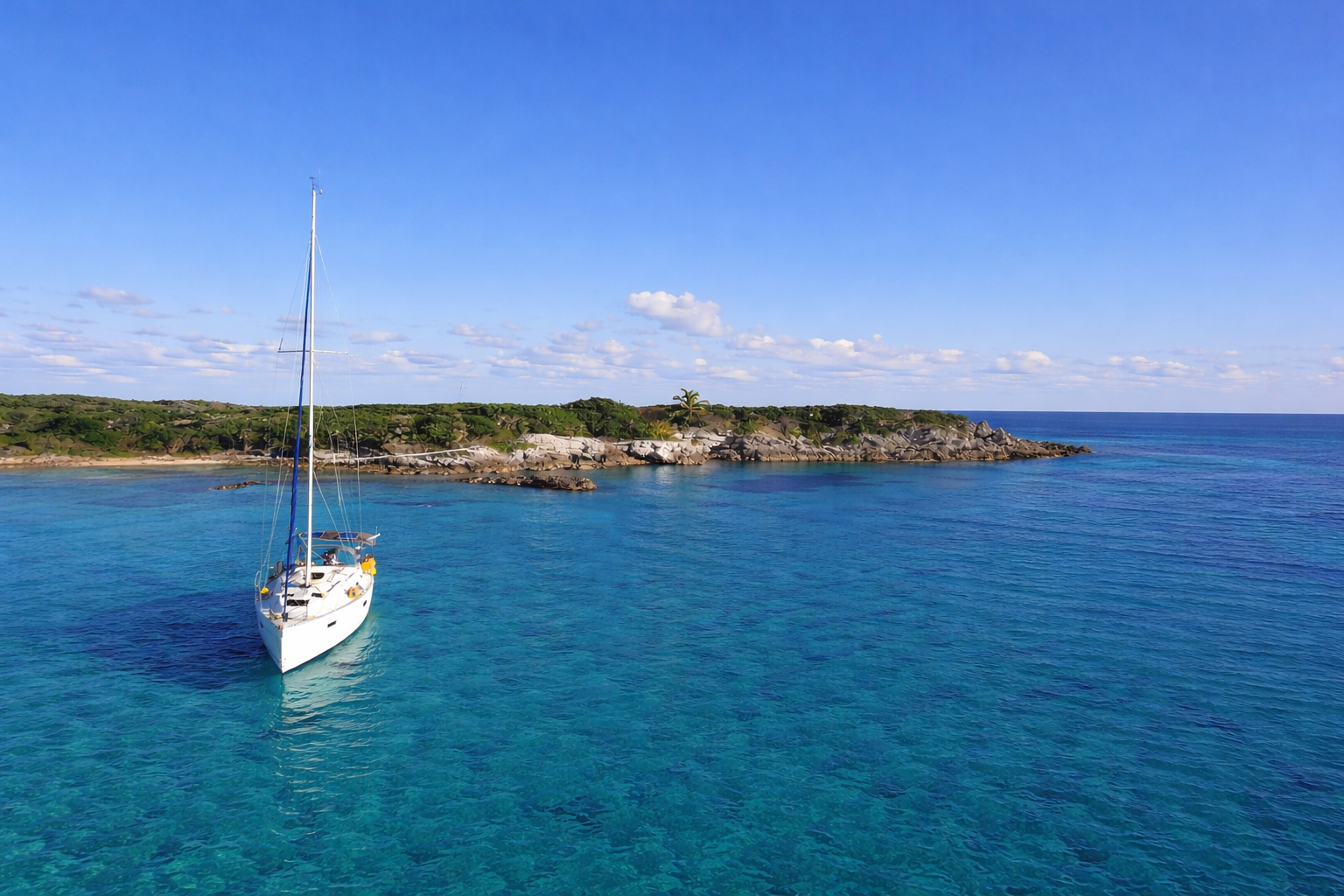
Exumas, Bahamas · 7-day liveaboard
Blended Basic + Intermediate Curriculum
Sail Canada Basic Cruising and Intermediate Cruising in one 7-day liveaboard course.
Overview
Course structure
Basic Cruising certifies you to skipper a 6 to 10 metre boat by day in familiar waters. Intermediate Cruising certifies you to skipper a 9 to 12 metre yacht in unfamiliar waters. It builds on Basic and adds engine and systems, voyage planning, chartwork, VHF procedure and the collision regulations.
The blended course covers both standards in one week. Skills are taught to the Basic standard first, then to the Intermediate standard. Candidates are in command of the vessel for most of the week, rotating through skipper and crew roles, with the instructor aboard to supervise and intervene when required. On Day 6 the candidate plans and skippers the passage independently.
Groups can be mixed. Basic, Intermediate and blended candidates can sail the same week on the same boat. Basic candidates complete the Basic objectives and write the Basic exam only. Use the Basic or Intermediate filter in the day-by-day plan to see the objectives for one standard.
The route is weather-dependent. Days may be reordered; the content does not change.
- Basic Cruising
- 38 afloat skills · written exam
- Intermediate Cruising
- 57 afloat skills · written exam
- Exams
- Closed book, 70% to achieve, Day 6
- Class size
- 2 to 4 students
- Route
- Nassau and the Exuma Cays
Before the course
Preparation
Student portal
Access starts at registration: online lessons, quizzes, practice exams and simulators for both levels. Plan for several weeks of regular study before the course.
Pre-departure Zoom
Online sessions with the instructor before the course.
Navigation and radio
Intermediate also requires Basic Coastal Navigation and ROC(M) VHF with DSC endorsement. These can be completed up to 12 months after the course. Basic Cruising legally counts in place of a PCOC, but that isn't widely known, so we suggest taking a PCOC course before you arrive. Intermediate is signed off once they are submitted.
Curriculum
Day-by-day plan
- Day1
Nassau to Norman’s Cay
Safety, systems and departure
Longest leg of the week. Vessel orientation and inspection at the dock, passage planning from the morning forecast, then departure.
At the dock
- Safety briefing; PFD selection and fitting Both
- Safety equipment located and condition checked: flares, EPIRB, extinguishers, first aid, throwable Both
- Vessel tour above and below decks: rigging, winches, through-hulls, seacocks, tanks and plumbing Both
- Diesel engine: battery bank, cooling and fuel systems; pre-start checks and start procedure Both
- Standing rigging, windlass, shackles and blocks inspected Intermediate
- Instruments, helm and engine controls tested Intermediate
- Water tanks, distribution and capacities Intermediate
- Tools, first aid kit and spare engine parts inspected Intermediate
- Head and holding tank: correct use, pump-out and environmental responsibilities Intermediate
Plan and depart
- Weather report obtained and interpreted from VHF and web sources Both
- Voyage plan built from the weather, anchorage chosen, sailing plan filed Both
- Tidal tie-up and departure plan, crew roles assigned Intermediate
- Dinghy rigged for towing Intermediate
- Departure from the dock: lines cleared, fenders stowed, traffic awareness Both
- Winch handling, coiling, heaving and cleating lines Basic
Under way
- Deploy and furl main and headsail, bear away and shut down the engine Both
- Sail and identify every point of sail Basic
- Hold a compass course Intermediate
- Day2
Norman’s Cay to Warderick Wells
Sail handling and moorings
Shorter leg, with most of the day spent on sail handling. Warderick Wells is in the Exuma Cays Land and Sea Park, where boats use park moorings.
Sail handling
- Tacking and gybing: crew briefed, clear commands, sheets and boom managed Both
- Sail trim: reading telltales, jib cars and the mainsail traveller Both
- Reefing under sail: sailing on the headsail only and on the mainsail only Both
- Sailing circles as a skills baseline Intermediate
Arrival
- Navigate a mooring field, pick up the ball with the boat hook, secure with redundancy Both
Chartwork
- Reading the chart: datum, soundings, aids to navigation, lateral marks Both
- Day3
Warderick Wells to O’Brien’s Cay
Crew overboard and navigation
Crew overboard recovery under sail and under power. Chartwork, and tidal planning for the cuts.
Crew overboard
- Figure 8 recovery under sail Basic
- Triangle method under sail Intermediate
- Heave to and falling-leaf recovery Intermediate
- Furl sails and return to the person under power Both
- Recovering the person aboard: methods discussed and demonstrated Both
Boat handling
- Heave to Both
Navigation
- True, magnetic and compass courses (variation and deviation) Both
- Tides and currents: planning a cut transit Both
- Two- and three-bearing fixes plotted on the chart Intermediate
- Dead reckoning: course, speed, distance, time and ETA Intermediate
- Day4
O’Brien’s Cay to Staniel Cay
Manoeuvring under power and docking
Close-quarters manoeuvring, then docking at the Staniel Cay marina.
Under power
- Steer a straight course, figure 8 forward and in reverse Basic
- Slow down, stop and reverse Basic
- Standing turns Intermediate
- Crew rotation at the helm Intermediate
Docking
- Prepare for arrival: fenders rigged, lines through the chocks, plan briefed Basic
- Docking: instructor demonstration, then independently Both
- Reverse from the dock Basic
- Springing on and off the dock Intermediate
- Stern-to docking Intermediate
- Snugging down: cleat hitches, walk-around, boat well placed Basic
Running the boat
- Fuel management: capacity, consumption and reserve Intermediate
- Dinghy and outboard handling, actions if swamped Intermediate
- Day5
Staniel Cay to Shroud Cay
Anchoring and VHF
Anchorage selection, anchoring and radio procedure.
Anchoring
- Choose an anchorage: depth, swing room, holding, hazards Both
- Scope from charted depth and tidal range (5:1 minimum, 7:1 recommended) Both
- Lower and set with the windlass, back down to confirm the set Both
- Hand signals between bow and helm Basic
- Weigh anchor with crew assignments, stow the gear Both
Navigation under way
- GPS fix plotted, DR revised and ETA updated Intermediate
Radio
- VHF procedure, channel use and the phonetic alphabet Both
- Sécurité, Pan Pan and Mayday calls, scripted and made by the candidate Intermediate
- Day6
Shroud Cay to Athol Island
Written exams and independent voyage
Written exams in the morning. In the afternoon the candidate plans and skippers the passage, and the instructor observes.
Morning
- Basic Cruising written exam, closed book, 70% to achieve Basic
- Intermediate Cruising written exam, closed book, 70% to achieve Intermediate
Final independent voyage
- Voyage planned and plotted by the candidate Intermediate
- Tacks and gybes without instruction Intermediate
- Heave to independently Intermediate
- Crew overboard recovery without instructor help Intermediate
- Anchoring for the night independently Intermediate
- Day7
Athol Island to Nassau
Return to Nassau and debrief
Return passage, final docking and assessment.
Arrival
- Return to port and dock independently Both
- Tidy and stow all gear Basic
Debrief
- One-on-one review against both standards and certification sign-off Both
- Everynight
At anchor
Evening theory
Classroom sessions, held each evening.
- Collision regulations: rules 1 to 19, lights and shapes, narrow channels, restricted visibility Both
- Sound signals, courtesies and customs at sea and in port Both
- Dinghy stowage methods Intermediate
- Exam review for both written papers Both
Standards
Afloat skills
Sail Canada afloat skills for each standard, grouped as they appear on the evaluation checklists. Intermediate skills marked Also Basic are covered in Basic Cruising and assessed to a higher standard at Intermediate.
Basic Basic Cruising 38 skills
Safety and vessel orientation 5
- Safety briefing, PFD sizing and fitting
- Selects and fits a PFD correctly
- Vessel tour above decks: deck hardware, rigging, winches
- Vessel tour below decks: systems, layout, companionway
- Safety equipment located: flares, extinguisher, first aid kit, VHF, throwable
Line handling 4
- Winch handling: loading, grinding, easing, cleating
- Coiling lines
- Heaving lines
- Securing the boat with a cleat hitch
Manoeuvring under power 9
- Pre-departure engine check: oil, coolant, seacock, raw water strainer, belt
- Engine start procedure
- Departure: cast off, stow fenders, close companionway, stow lines
- Steer a straight course
- Figure 8 under power
- Slow down, stop and reverse
- Reverse figure 8
- Reverse from the dock
- Approach and pick up a mooring ball
Anchoring 5
- Choose an anchorage: depth, swing room, holding, hazards
- Calculate scope (5:1 minimum, 7:1 recommended)
- Lower and set the anchor, back down to confirm
- Hand signals between bow and helm
- Retrieve and stow the anchor
Sail handling 8
- Deploy and furl the mainsail
- Deploy and furl the headsail
- Set sail, bear away, engine off
- Identify and sail all points of sail
- Tacking
- Gybing
- Sail on the headsail only
- Sail on the mainsail only
Crew overboard 2
- Figure 8 recovery under sail
- Furl sails and return under power
Return to dock 5
- Prepare for arrival
- Docking, observing the instructor
- Docking independently
- Snugging down and walk-around
- Tidying and stowing all gear
Intermediate Intermediate Cruising 57 skills
Safety and vessel inspection 8
- Condition of all safety equipment checked, including EPIRBAlso Basic
- Tools, first aid kit and spare engine parts inspected
- Through-hulls, seacocks and plumbing identifiedAlso Basic
- Water tanks, distribution and capacities
- Standing rigging, windlass, shackles and blocks inspected
- Instruments, helm and engine controls tested
- Halyards, sheets, clutches and winch handles identified
- Head and holding tank: use, pump-out, environmental duties
Engine and systems 4
- Battery bank, cooling and fuel systems explained
- Engine checks: oil, coolant, seacock, strainer, beltAlso Basic
- Engine start and warm-upAlso Basic
- Fuel management: capacity, consumption, reserve
Navigation and voyage planning 8
- Weather obtained and interpreted from VHF and webAlso Basic
- Voyage plan built from the weatherAlso Basic
- Sailing plan filedAlso Basic
- Chart datum, soundings, aids to navigation, lateral marksAlso Basic
- Two- and three-bearing fixes
- Dead reckoning: course, speed, distance, time, ETA
- True, magnetic and compass coursesAlso Basic
- GPS fix under way, DR revised, ETA updated
Getting under way and manoeuvring under power 7
- Tidal tie-up and departure plan, roles assigned
- Dinghy rigged for towing
- Departure from the dock with traffic awarenessAlso Basic
- Crew rotation at the helm
- Springing on and off the dock
- Stern-to docking
- Standing turns
Sailing 8
- Deploy sails with crew assignedAlso Basic
- Sail trim: telltales, jib cars, travellerAlso Basic
- TackingAlso Basic
- GybingAlso Basic
- Holding a compass course
- Reefing under sailAlso Basic
- Heave toAlso Basic
- Sailing circles
Anchoring and mooring 5
- Anchoring with charted depth, tidal range, scope and windlassAlso Basic
- Weigh anchor with crew assignmentsAlso Basic
- Mooring field, pick up and secure with redundancyAlso Basic
- Dinghy stowage, several methods
- Dinghy and outboard handling, actions if swamped
Crew overboard 4
- Triangle method under sail
- Heave to and falling-leaf method
- Furl sails and return under powerAlso Basic
- Recovering the person aboardAlso Basic
VHF and communications 4
- Operating procedure, channels, phonetic alphabetAlso Basic
- Sécurité call
- Pan Pan call
- Mayday call
Collision regulations 4
- Rules 1 to 10: rules of the road, lights and shapes, narrow channelsAlso Basic
- Rules 11 to 18: meeting, crossing and overtakingAlso Basic
- Rule 19: restricted visibilityAlso Basic
- Sound signals, courtesies and customsAlso Basic
Final independent voyage 5
- Voyage planned and plotted by the candidate
- Tacks and gybes without instruction
- Heave to independently
- Crew overboard recovery without instructor help
- Return to port, docking or anchoring independentlyAlso Basic
Choosing a format
The blended course suits candidates with prior sailing experience who will study before the course. Candidates can also take Basic Cruising or Intermediate Cruising on its own, in the same group as blended candidates.